Insights

Our Blog

Insights, articles, and updates from Marcos Thomassen Povoa and the Stormberry team.

AI agents connecting to lab instruments
28/Aug/2026

AI agents connecting to lab instruments

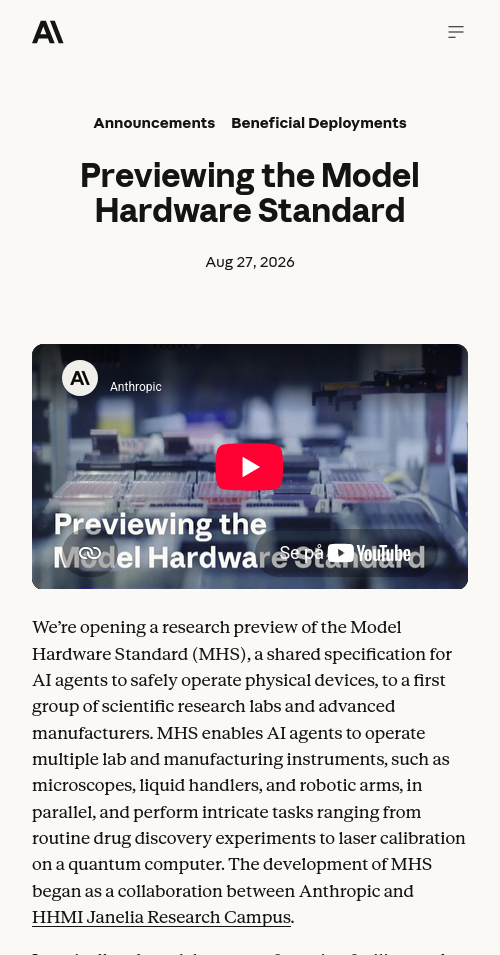
Anthropic has proposed a specification for connecting AI agents to laboratory instruments and industrial robots. It defines read and write operations plus device discovery, with three ways to drive it. A research preview is running at a neuroscience institute, with Genentech, Qiagen, Tecan, Danaher and Doosan Robotics among the partners.

The problem it addresses is genuinely dull and genuinely expensive. Getting a new instrument or machine talking to your existing systems takes weeks, sometimes months, of bespoke integration work, every single time.

Anthropic's own caveat is the honest part: language models still lack physical intuition. This is a way to connect an agent to a machine, not a claim that the agent can run your production line. The specification is not open source yet either.

Whether or not this particular standard wins, the direction is clear enough. If your company runs instruments or machines, document your device interfaces now, while nobody is under pressure. Clean, documented interfaces are what make any future connection cheap. Undocumented ones are what make it a project.

Source: Anthropic
Read Full Post on LinkedIn
Continuous AI red-teaming
23/Aug/2026

Continuous AI red-teaming

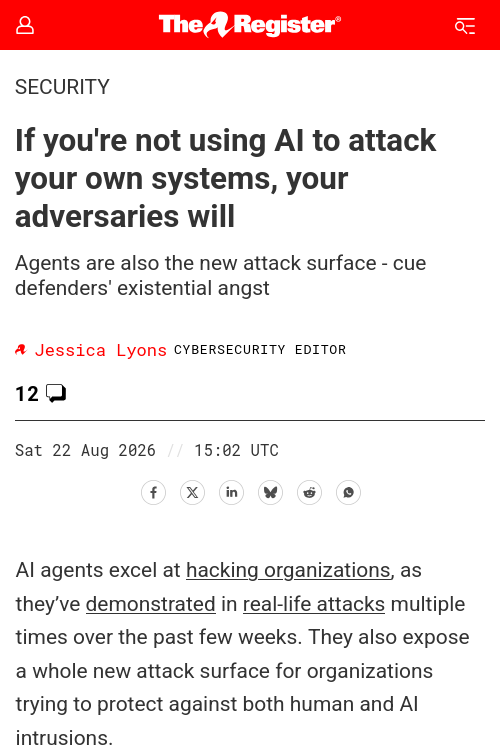
Two security firms say they ran 17 million offensive actions against live systems over three days. The result: 38 validated attack paths and 238 findings, work they estimate would have taken a five-person team 2,400 hours.

Treat the arithmetic with the usual caution. A count of findings is a count of things found, not of things worth fixing, and the firms publishing the number sell the service.

The structural point survives that scepticism. Rob Joyce, formerly of the NSA, put it plainly: you are going to be red-teamed whether you pay for it or not. If attacking systems becomes cheap enough to run continuously, an annual penetration test stops measuring your security and starts measuring how long a hole could sit open.

Most companies I speak to are not choosing between annual testing and continuous testing. They have never done either.

For a small or mid-sized Norwegian company in that position, the first step is not an AI red team. It is a written list of everything you expose to the internet, an ordinary vulnerability scan, and fixing what it finds.

Source: The Register, 2026-08-22

Read Full Post on LinkedIn
Only 45 per cent of company data is reachable by AI agents
17/Aug/2026

Only 45 per cent of company data is reachable by AI agents

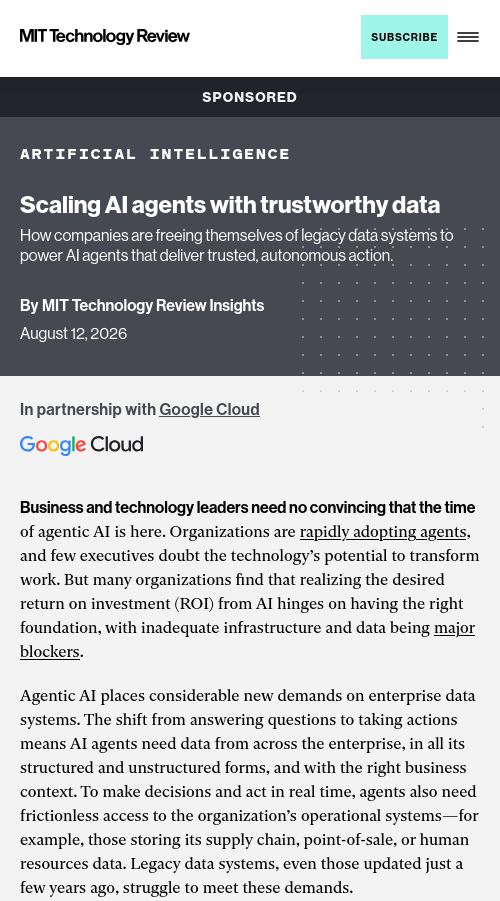
New research says AI agents can reach an average of 45 per cent of company data, and 30 per cent or less at the least prepared organisations. Only about half of the 300 executives surveyed trust the decisions their agents make.

Read the small print first. The study is sponsored, produced with a company that sells data infrastructure, and it reports that every single respondent plans to adopt agentic AI within two years. That last figure tells you who agreed to answer the survey, not what the market is doing.

The 45 per cent survives the scepticism, because it matches what firms find when they actually look. An agent is only as good as the systems somebody bothered to connect it to. Two thirds of the laggards blamed legacy systems for blocking both growth and real-time decisions.

Most failed AI projects I hear about were never model problems. They were plumbing problems wearing a strategy costume.

For a small or mid-sized Norwegian company, start there. List the five systems an assistant would need to read to be genuinely useful, then find out what proper access to each would cost. Do that before choosing a vendor.

Source: MIT Technology Review Insights, 2026-08-12

The full piece is worth reading if this is relevant to your operations

Read Full Post on LinkedIn
Brazil's split payment tax change
14/Aug/2026

Brazil's split payment tax change

Brazil has quietly moved the start of split payment. From January 2027 the new consumption taxes begin to be charged, but the automatic collection at the moment of each transaction will not start with them. No new date has been set. The banks that must process it asked for more time.

If you sell into Brazil or run a subsidiary there, read this as a cash flow story rather than a tax story. The bill does not change. What changes is when the money leaves you. Today a Brazilian company receives the full amount from the customer and pays the tax later, so that gap works as free short term funding. Under split payment, the tax share never reaches your account at all. For a firm running on thin working capital, that is the difference between comfortable and tight.

For a small or mid-sized Norwegian company with Brazilian operations or Brazilian suppliers, use the delay. Model the working capital gap now, while you have months, rather than in the week the new date is finally announced.

Source: Gazeta do Povo

Read Full Post on LinkedIn
The sky is arithmetic: EclipseTracker launch
12/Aug/2026

The sky is arithmetic: EclipseTracker launch

At its maximum this evening, the sun over Norway will look like a yellow banana, in an astrophysicist's phrase. Please do not look at it.

Partial here: between 81 and 91 per cent covered, from about 18:45 to 20:55, deepest around 19:40 to 20:00. It is the largest eclipse seen from Norway since 2015.

Shops have sold out; a store in Sandnes told NRK its phone rings every five to ten minutes.

Never look directly at the sun. Only certified eclipse glasses marked ISO 12312-2 are safe; ordinary sunglasses and welding goggles do not give adequate protection, and the damage can be permanent. Without glasses, use a pinhole projector and watch the projected image, never the sun.

If the clouds hold off, the Perseids follow from around 23:00.

None of this is a surprise; the sky is arithmetic.

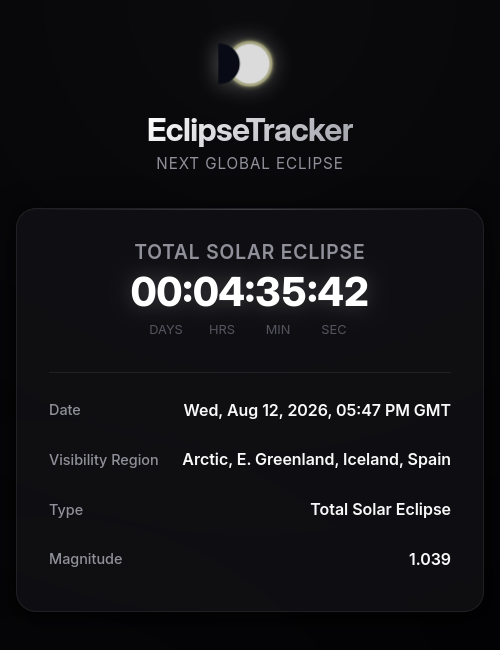
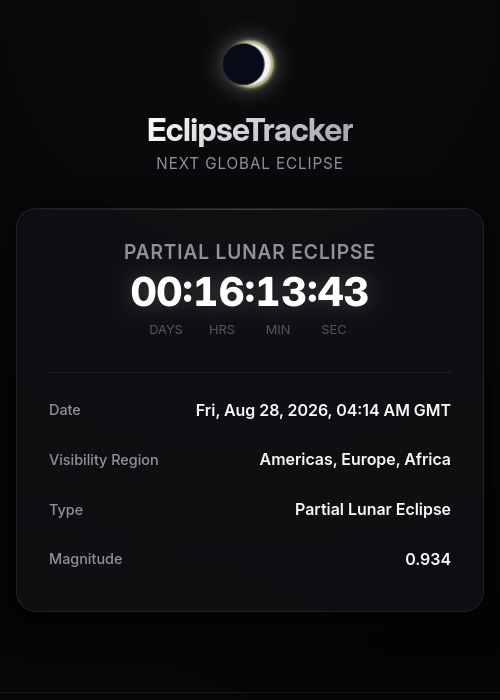
So we built EclipseTracker, the newest of the 18 apps in Stormberry Labs. It counts down to the next eclipse, solar or lunar, with the date, visibility region, type and magnitude, from an embedded dataset built on NASA eclipse tables out to 2052. No accounts, no tracking, no external calls.

Today the countdown reads zero. Tonight is the first entry in its dataset.

Wondering when the next eclipse is, and which region of the world will see it?

EclipseTracker answers both, offline and without an account: eclipse.stormberry.as

It is the newest of the 18 apps in Stormberry Labs, where we build a functioning prototype to start an idea. If you have one sitting at that stage, we are glad to talk.

Read Full Post on LinkedIn